Podcast / Episode #42
Episode #42: Do Governments Trust Communities
By Renae Hanvin
24 February 2026
This episode
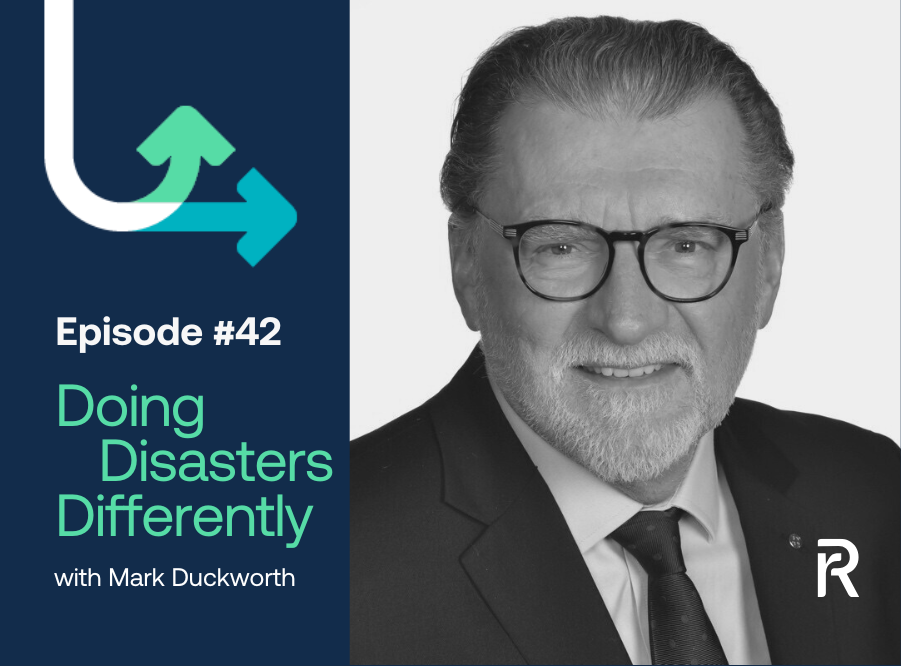
In this week’s episode of Doing Disasters Differently, Renae is joined by Mark Duckworth, Associate Director at the Centre for Resilient and Inclusive Societies (CRIS) and Senior Research Fellow at the Alfred Deakin Institute for Citizenship and Globalisation at Deakin University, with more than 30 years’ experience in senior public sector and resilience roles, including contributing to the National Strategy for Disaster Resilience (2011). Together, they explore whether governments truly trust communities, unpacking the role of trust, social capital and social infrastructure in disaster resilience, and why resilience must be built with communities, not delivered to them.
key moments from the conversation
I met Mark back in my Australia post days, so we’re talking about, I don’t know, 12 or so years ago in one of his roles at the Victorian government. And straight away I was just intrigued by his whole focus and take and approach around disasters. I was really interested because obviously he has a government lens and I’ve never, as we know, I’ve never worked in the government side of the things, but I was just always been really fascinated by how he thinks about disasters.
Renae Hanvin (02:16):
Mark, thanks so much for joining me today. You have been a podcast guest a few years ago, so it’s really wonderful to chat with you. And in the introduction, I reminded myself that you were part of the 2011 national Strategy for Disaster resilience, which I love and always talk about the notion of shared responsibility. I think it’s so relevant today as to what it was. So it’s been a little while.
Mark Duckworth (02:39):
Yes, indeed. And it’s great to be here and to talk about these things which are becoming increasingly important. And I think one of the key things that the recent reports we put out on trust and some of the other things that I’m working on is that what we are seeing really is a convergence of threats, not just in Australia but globally and in the emergency management world and the world of disasters, there is sometimes a tendency to focus on the immediate issue, whether it’s a bush fire or a flood or something like that. And communities quite rightly expect in Australia that government agencies will provide world-class risk analysis and preparedness and response and all that’s really important. But effective disaster planning also requires social capital and developing that through investment in community and community connections and those things are all connected. I think one of the other things sinking globally is that last year the World Economic Forum put out its annual survey of global risks ranked by severity. And I think it’s notable that among the top four is number one is misinformation disinformation. Number two is extreme weather events, and number four is social polarisation. And all of these are connected. So it’s not possible anymore just to say we’re just going to focus on extreme weather events. We also need to focus on what’s happening around misinformation and social polarisation, which are closely connected to, and also I think it’s important for people to really understand that.
Renae Hanvin (04:36):
Yeah, I think the notion of the sector, I guess the disaster or emergency management sector has certainly evolved. And I hate to say it, but I say to people, it’s a growth sector is how I kind of look at it. Not that we want it to be, but I think the reality of the different types of disasters and challenges that are hitting our communities compounding really is quite frightening. So today we’re going to talk about do governments trust communities? And it’s a report that you and Christine Horn and Michelle Grossman did in 2024, which I love and I refer to a lot. It’s about a trust flows project research report. So how did that come about?
Mark Duckworth (05:17):
Well, I think one of the things is that I’ve been focused on for many years, including when I was working in government, was that we have a large number of policies that talk about community engagement, empowering communities, talking about communities at the center of all that we do and things like that. And also many government reports talk about methods which government agencies can use, including co-production and so on. One of the key things about the term empowerment that government is going to empower communities, it actually means giving up some power to communities. You can’t both empower and control at the same time. And so this is one of the things that I’ve been thinking about for some time. Michelle Grossman in an article talked about trust flows about what she referred to as a Maori systemic flow of trust. And I think it’s important when one’s thinking about trust is to recognise that it’s not something that just goes one way.
(06:25):
It goes a number of different ways. At its simplest, one can say that there is vertical trust such as a twin government and communities and communities and government. There’s also horizontal trust in addition to vertical trust. And horizontal trust is trust between individuals and communities. And this is closely connected with our understanding of resilience because I think in many reports and resilience, one of the key phrases is that connected communities or resilient communities, you can’t have community resilience without connectedness. And that one of the things that we need to focus on is building that connectedness and building the way in which individuals and communities relate to each other from that communities get their strength. Now the role of trust in this is that trust is the glue that holds society together. And that without it, our society really can’t work based upon a whole series of things, which includes confidence, expectations that the individuals or organisations are going to act in a certain way. And when that trust breaks down and that people no longer feel confidence in whether it’s in government or institutions or other members of society, that leads to polarisation and leads to a number of connected things. Earlier last year, Edelman Trust barometer put out its 2025 report about Australia, which had a rather stark comment, which said that Australia has slipped into distrust territory with a profound global shift to acceptance of aggressive action and deepening fears giving rise to a widespread sense of grievance.
(08:20):
And one of the things is when from looking at work around issues around extremism and so on, one of the things which underlies most extremist movements is in fact a sense of grievance that whether it’s other members of society or governments are somehow failing them or that the systems failed them. And that sense of grievance means that people do not have a stake in society. And in fact leads to that polarisation, some of which we see in Australia, but in other parts of the world is more evident. And these things are closely connected to emergency management because one of the consequences of this collapse of trust is that if you do not trust government, it means that you frequently no longer trust the information that government’s providing and emergency management agencies depend put on their information being trusted and acted upon. And if we are moving into what some people call a post-truth world in which people are either confused about which type of evidence to rely on, then that creates these problems.
(09:46):
We’re seeing a decline of trust in experts. We are seeing a decline of trust in government information. And we’ve seen both in Australia and in the United States, for instance, during emergencies, some bizarre conspiracy theories arising about the causes of whether it’s a fire or a flood, which have no basis in any known reality, and yet they exist on the internet. And the way in which our social media works these days is that once you start going down a rabbit hole of conspiracy theories, you’re more likely to believe other conspiracy theories and they reinforce themselves and people then end up in an entirely different reality. And that’s a big problem when emergency management agencies assume that when they put out a piece of information or this is going to happen or do this, that the creators, we going to trust them act upon it. Yeah. So I think it is actually an issue which is not just as kind of fringe issue around disaster resilience becoming increasingly a central issue.
Renae Hanvin (10:51):
Yeah, it’s interesting. As you know, we delivered the project with Professor Daniel Aldrich in last October, launched the national social capital and social infrastructure measurement framework and the descriptor we have around social capital, the connections, trust and cooperation between people. So certainly when we went on a discussion tour and spoke to every state and territory, trust was the first word when we’d say what is social capital and what does it mean connection, absolutely. But trust was absolutely so high on that list. And then the national mapping tool that we created, which was a global first, I’ve just come back from Dubai, which was very exciting to recognise it. We’ve actually mapped in three pilot communities, Adelaide, kangaroo Island, and Whyalla, the levels of bonding, bridging and linking ties. And those linking ties being the connections between people or citizens and those in roles of authority or power for the majority is actually very, very low. Which is I think quite representative of what you’ve just said, that the levels and the trust between people and those in decision-making roles or government roles is quite low at the moment. And do you think governments kind of recognise it and they see it as a, I don’t know, they see it as a problem in the resilience ecosystem that needs to be addressed? Or do you think they just keep doing what they’re doing and we will follow type thing or we’ll grow to trust?
Mark Duckworth (12:16):
Well, one of the things which I often reflect on is that we’ve been talking about this for quarter of a century, and if it goes back to 2001, there was a report to Coac, the Council of Australian Governments was then the forum which the prime minister and the premiers all met, which was talking about the costs of disasters. And that alarmed the premiers and the prime minister so much they commissioned an expert report which went to coag as I mentioned almost 25 years ago. That report set out was entitled Reforming Mitigation Relief and Recovery Arrangements. And it said that the real aim was to build community resilience by constraining and time reducing damage and costs to the community and all levels of government through cost-effective mitigation, recognising of course that major unforeseeable disasters will continue to happen. But the key that it talked about was about a paradigm shift to a focus on mitigation and prevention.
(13:28):
And since that time there has been increased resources put into mitigation and prevention, but compared to the amount that we spend on response is in fact is a very small percentage, we’re doing better. But that paradigm shift, which was called for quarter of a century ago, has not happened. And one of the questions that we have is what are the impediments to that? And many of these are ones around centuries political, not party political, but in terms of what is regarded as important. And I think that one of the things which I’ve often said and I think and other people have said is that we invest a lot in physical infrastructure. We invest very little in social infrastructure, and yet it is social infrastructure, which is fundamental for dealing with disasters, disaster resilience and effective recovery post-disaster. For some reason it’s just very difficult to get governments to invest in social infrastructure.
(14:37):
Some people cynically say, well, you can’t take a photograph standing in front of avoided costs. And that’s true that in fact it’s one of the issues that we have is the need to convince treasuries and others is that this type of investment is in fact not only good in itself, but it in fact over time will reduce costs. So there are financial benefits, but we’re just not doing it. And I think one of the things that we’re focusing on in this report on trust is not just saying that we need to get involved in, people need to start trusting each other more, but there are some practical steps that governments and their agencies can take to actually increase trust. One of the things which is specifically related to emergency management that I hear again and again and indeed a discussion with some community members just yesterday was hearing is that one of the big issues which communities see is that for instance, the turnover of staff, you have a disaster, someone’s brought in communities talk to individuals six months, 10 months later they go and do something else and you have to start all over again.
(15:51):
And this is seen by communities as in fact a lack of investment by governments in those communities that in fact it’s not taken particularly seriously and that the community engagement post-disaster is not given a particularly high priority. And it’s one of the things that we talk about in our report, as you mentioned from 2024 and we spent a bit more time in the report we put out about six months ago, is that government agencies need to make community engagement not only priority but also something which is regarded as important. And indeed, one of the things that happens with people in government is that the longer people in government, as they rise through the ranks and become more seniors, they spend less time talking with communities,
Renae Hanvin (16:47):
With communities
Mark Duckworth (16:48):
And they spend more time talking with ministers, which is fine, but it also is important that they’re grounded in talking with community members as well. And we suggest to quite some practical things, for instance, that there are all sorts of administrative reasons why people can’t stay in the community forever, but it’s possible, for instance, to actually have a plan to hand over between one person or another and to make sure that this is not just a question of communities having to explain themselves all over again.
(17:20):
And I think that’s one of the main issues we have. Another thing that we talk about again, which is looking at practical things that governments can do, and we hear this again and again as a way that the grant system works, is that you end up with a competitive grant system that communities have to compete against each other for limited funds. And we often see that communities feel that because there are so many, many conditions on the grants and so much red tape surrounding them, communities may have objectives and aims they want to achieve, but they end up delivering on government objectives, not on community objectives. And so there’s a sense of very strong frustration around the fact that this money is not actually being used to deal with the essential community needs. So there are some steps and the whole series of other things that we talk about too in our report, the government individuals and agencies can take to actually at least not rupture the relationship with trust. Because the key thing that we talk about is that the relationship with trust is based on reciprocity. And while there’s a lot of focus on do communities trust government, as you said at the beginning, our report is do governments trust communities? Because for relationship of trust, there has to be trust by government in communities.
(18:52):
For some people within government and some agencies trusting a community is seen as a risk because you are actually not just simply delivering upon a government priority, but the community may have different priorities. And so this actually creates this problem that some government agencies feel they can’t trust communities
(19:16):
Because the government agencies feel that they’re there to deliver government priorities. And what if community has different priorities then in fact it creates some problems for them. So it goes back to that initial issue I was talking about is that empowerment does require giving up some power. And so there has to be a willingness to understand that communities need to have agency that they need to, that things need to be done with communities not to them. And the more that governments in the emergency management world do things to communities and not with them, then that actually leads to decline of trust. It also means that disaster resilience becomes more and more difficult to achieve
Renae Hanvin (20:01):
More. Mark, I could just listen to you because you are just singing my song in every word that you say. I think everything that you’ve said I thousand percent agree with, I find that I guess the funding and the focus in my opinion in the disaster space is often token sort of tokenistic or it’s led by outputs, so not outcomes. It’s led by how many press releases can we put out, how many numbers of grants that we can put out. And I wholeheartedly agree with the community grant problem being that it actually does the opposite of building social capital. And I remember after the bushfires in New South Wales, I think it was the area of bega at one point in time had 32 projects that were funded. Now Bega doesn’t have 32 project managers and it probably didn’t need 32 projects. It probably actually wanted three or four core issues addressed and identified.
(20:56):
But because the government decided that the funding process would happen in that way and they wanted press releases and whatnot and all good intent I’m sure, but I think we need to move the focus to outcomes. And the outcomes needs to be that we need to build social capital in our communities. We need to understand and actively invest and measure in how connected trust cooperation between people and those places and spaces, the caravan parks that pop up when disasters occur and they’re feeding people and they’re taking in people and housing people and taking in animals, and then the libraries that are the places that people can go to in heatwaves and refuges and digital connections. And I think there is a massive level of, I’m not saying ignorance, but I just think a lack of willing to consider that we need to be doing disasters differently and social capital and social infrastructure really should sit at the core of how we look at building community resilience.
(21:57):
And obviously trust is a massive place in there. Now in your report you talked about some of the key findings that for trust to grow such relationships need to be tended and carefully maintained. And I always love a good old coffee and chat with people. So basically we need to build and strengthen social capital. So whilst so much funding and a lot of funding, I think a vast majority of funding is going into the flood levies and the physical infrastructure. But there is so much value in putting funding into connecting communities, getting them to come together. And we’re actually delivering a couple of projects with the city of Casey where we’re bringing them together. One project is we’ve just created a sticker that’s going out to every household to stick on a box. So everyone in that it’s a very urban area, will have a box that they can follow that they can if there’s a heat wave or a power outage or whatever it might be. So little simple things, but some of the key to creation and maintenance of trust building behaviors. Can we talk about some of those? I think there’s about eight or so in your report, but what are the key ones that you sort of recall or think to focus on?
Mark Duckworth (23:07):
Well, I think one of the things is that building trust or the ability to build trust between government officials and communities is something that can be taught and we need to actually regard it as a trade craft that
(23:21):
Public servants have and other people working in government. And indeed, often this type of training exists for people working in humanitarian aid where building community connection is understood to be a prerequisite to delivering aid. Whereas when we look at things domestically, that’s actually regarded as not particularly important, that type of focus on building community connection. One of the things that we would want to focus on, and this links to this issue about some of the characteristics, is that the training should develop on those behaviors which build trust. And one of the key things we indicate in our report is in fact trust is built or broken through behaviors. And first of all is the focus on building and maintaining relationships, expanding familiarity and awareness, people understanding the communities which they’re working with, increasing cultural awareness and competence frequently that may be lacking. Establishing proper communication strategies, which is not the same as just putting out media releases actually is communicating.
(24:35):
And also a focus not just on taking people but also listening. And I think that’s one of the key things and the feedback I have had, and I’m no doubt you’ve had, is that the individuals and agencies who communities most like working with or those people are not just there just to stand up and the local dictate and tell people stuff, but actually to be listening and hearing and adjusting the policies relating to that and some of those characteristics which were once to see include things such as empathy and that to be shown as well. There are many people working in the emergency management world who work closely with communities and communities trust ’em enormously because of that level of empathy which they show and that understanding that they show. And I think that’s one of the other things that’s important too, to actually understand these things.
(25:31):
There’s issues of respect as well. People are not often consciously disrespectful, but it can be seen to be disrespectful if you don’t invest the time or if someone comes in from city Melbourne and Canberra for the day and then goes back and they don’t see me again for six months or something. And that is linked to this kind of idea of openness as well as they’re open about the process about what’s going on, this is what we can do, this is what we can’t do. If people are promised things and then they’re not delivered on, then that breaks trust as well. There may be reasons as one though the world’s a complicated place, it may well be that circumstances change and so on, but it’s a question if people in agencies are open about this is the process we thought we could do this, but all these other things have happened and we’re going to have to change. It’s a question of actually continuing that dialogue as well. And one of the other things, one of the other characteristics which we talk about, which actually is essential for trust, which is really difficult for people in government positions actually is vulnerability,
(26:46):
Which is that you can’t just kind of put up a hard wall and not shift or not move, but in fact it indicates an awareness that things may be difficult and complex and that in fact things are not easy for us or they are for you. In that type of building, that concept of collective responsibility, one of the things is, as you mentioned, the national strategy of disaster resilience. One of the lines we put in that was that this was about long-term behavioral change. Now one of the things that I think many people in government thought was, oh, this was about communities need to change their behaviors, but it’s also about people in government need to change their behaviors. So that long-term behavioral change is about government agencies and individuals changing their behaviors too, and that’s often overlooked. Likewise, the concept of that collective responsibility and shared responsibility, shared responsibility has always been stated to be, and it was in that strategy from more than 15 years ago that shared responsibility has not been equal responsibility.
(27:55):
Government agencies will often have more responsibility. Certainly communities have responsibility too, but that is not something to say that we’re abandoning you, we’re leaving you alone. It’s also part of this two-way street and this reciprocity that it’s not governments and communities existing in parallel paths, but connecting frequently and talking to each other about what needs to happen. So all these things are really about behaviors and the type of behaviors that we can see. I think a further thing, which is also the case is I think, and again you would’ve heard this, but many communities are frustrated by the fact that government agencies often see community time as free, that it’s actually a free good that can be used for as much and as often as required. But everybody in an area which has been affected by or is preparing for a disaster, people have their own jobs, their own business, their own other responsibilities as well. And there’s often a lack of investment in that.
Renae Hanvin (29:12):
And
Mark Duckworth (29:12):
Criticism that I’ve heard again is that government funding may go into certain sources that people come in and do stuff, but the funding isn’t going to the community or building community capability so that it’s C has become able to manage projects as well because it’s no good saying, oh, this community doesn’t have enough experience to manage this complex projects that we have to do it for us. One of the basic understandings around humanitarian investment is that you actually want to invest in that community capability. You don’t just need people coming from outside and doing stuff and then retreating after a few years that you actually want to actually have that long lasting effect. And going back to that report from 25 years ago, that in type of investment in mitigation and in communities is something that needs to h HP a lot more of that. It’s not particularly expensive compared to the 38 billion a year that disasters cost us, but we do need to put a lot more money into that to actually bring about some long lasting change.
Renae Hanvin (30:34):
Absolutely agree. And I guess my passion around social capital and bringing Professor Aldridge’s work to Australia is to hopefully do exactly that, to have some evidence around our invisible infrastructure. And I’m hoping crossing fingers that it’ll go through the process of being formally endorsed by NEMA as a formal part of the disaster resilience ecosystem because we have to start including the social fabric and the people connections and what is really core to our communities that we just decide to ignore or governments just decide to ignore. So certainly on a mission and Mark, I could talk to you for hours and hours and in fact I have about 30 questions I’m going to ask you once we’ve finished this podcast. But just to wrap up, I always like to end with the same question. What two things do you think need to be done differently in the disaster space? And I’m sure you can think of many more than two, but what would be the two?
Mark Duckworth (31:31):
I think we need to invest in community building and community capability and regard that as not just an add-on, but a priority. And connected to that is we need to put our money into building social infrastructure and not just physical infrastructure and recognise what those benefits are. I think those two things we can do, and both of them are connected to investment in mitigation and prevention and not just in response.
Renae Hanvin (32:05):
A hundred percent agree. And it’s a shame, I guess in some ways that 25 years ago it started the kind of focus on this and I mean 25 years later, has it evolved? I guess yes, to an extent, but I think there’s a real opportunity now to really take that next step and drive some systemic change. Mark Duckworth, thank you so much for coming back to be a guest again, and we’ve been talking about do governments trust communities. I feel like we’re going to have some more podcasts coming up, lots of alignment in the conversations there, but really awesome to talk with you again. Thanks so much.
Mark Duckworth (32:36):
Thank you very much.
Mark Duckworth (31:31):
I think we need to invest in community building and community capability and regard that as not just an add-on, but a priority. And connected to that is we need to put our money into building social infrastructure and not just physical infrastructure and recognise what those benefits are. I think those two things we can do, and both of them are connected to investment in mitigation and prevention and not just in response.